By: Sid Peddinti, Esq.
Lawyer. Biohacher. Investigative Publisher.
Friends, my journey into the intricate world of biohacking and cellular longevity began not in a lab, but in the ashes of a thriving bakery I was forced to shut down in the mid-2000s, a direct consequence of suboptimal legal, tax, and financial decisions, despite having what I believed were expert advisors.
That profound experience ignited a philosophical curiosity within me, compelling me to delve into root causes, to become a researcher, a lawyer, a tech builder, biohacker, and a publisher – always seeking truth directly from source materials, whether court cases, tax codes, clinical trails, patents, or government publications, rather than relying on market hype.
In an era brimming with noise across every domain- from legal and financial planning to career pathways and even biohacking supplements- the hunger for genuine knowledge is particularly pronounced in the evolving field of longevity science.
My unique perspective, shaped by years of legal and business structuring, has taught me to approach scientific literature with the same rigorous “legal thinking” framework ingrained in every lawyer: IRAC.
- Issue: You identify the core problem or question we are trying to understand, much like a legal dispute.
- Rule: You review the applicable rules, established facts, or scientific principles, such as NAD+ being an unstable molecule found in every cell whose levels naturally decline with age.
- Analysis: You apply and analyze these rules or guidelines against the core problem, scrutinizing what scientists are testing in their experiments and clinical trials- examining specific molecules, existing conditions, test parameters, and critical factors being measured.
- Conclusion: You determine what the clinical test or experiment demonstrates, establishing whether NAD+ levels increase, decrease, improve, diminish, or alter the tested parameters, or if the results are inconclusive, or show no impact.
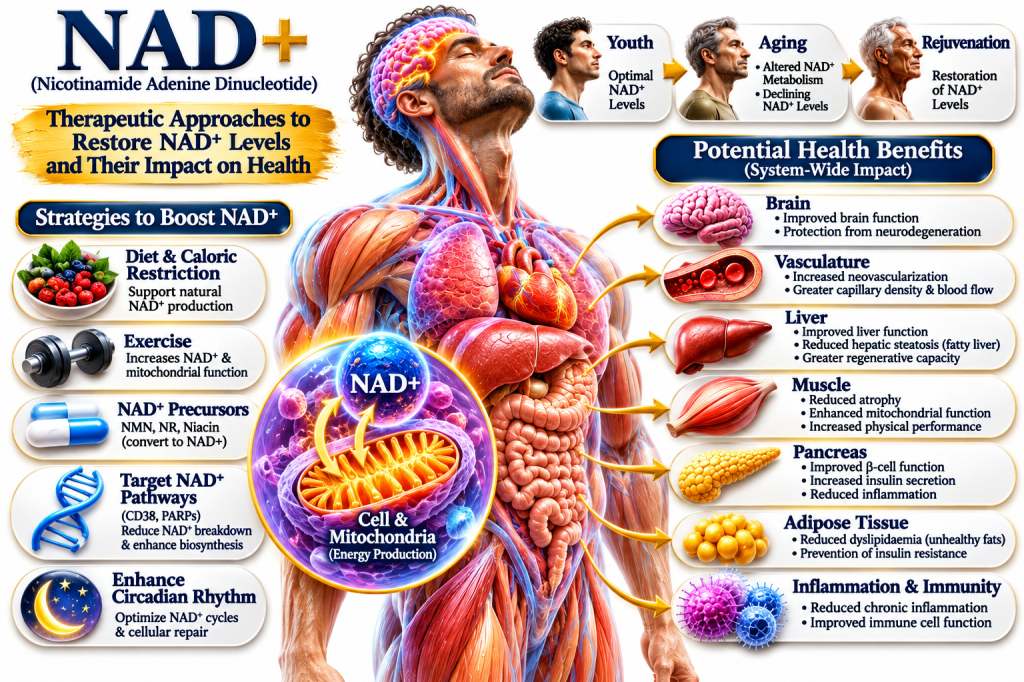
Applying this analytical rigor, I’ve delved into human clinical evidence surrounding NAD+ supplementation, compiling a comprehensive overview of its impact across four major organ systems as revealed in recent trials.
Disclaimer: I am not a doctor. Nothing here is medical advice. No claims are being made. I’m sharing my own research in an online magazine (that’s what I do: research and publish) and hope others, who are also curious and researching, can find value in our articles, blogs, and content. I do not own any of the product or brand names mentioned in the article below. Also conduct your own research.
Here is what the human clinical evidence actually shows across four major organ systems:
1. Brain Health & Cognitive Function
Neurons consume vast amounts of ATP, making the brain uniquely vulnerable to NAD+ depletion—a feature documented in Alzheimer’s and Parkinson’s disease (Lautrup et al., 2019).
- Crossing the Blood-Brain Barrier: In the landmark NADPARK Study (Brakedal et al., 2022, Cell Metabolism), 30 Parkinson’s patients taking 1,000 mg/day of Nicotinamide Riboside (NR) for 30 days showed verified increases in cerebral NAD+ via brain imaging (31P-MRS), altered brain metabolism, and reduced inflammatory cytokines in cerebrospinal fluid.
- Executive Function & Endurance: Yi et al. (2023/2024, GeroScience) conducted a double-blind RCT of 80 adults (300 mg to 900 mg/day NMN for 60 days), demonstrating dose-dependent blood NAD+ elevation alongside improved walking endurance and subjective health scores. Other trials (Martens et al., 2018/2023) have evaluated prefrontal executive function and cerebral blood flow in older adults.
- The Clinical Reality Check: A 24-week double-blind trial evaluating 2,000 mg/day of NR in adults with long-COVID (NCT04809974) raised whole-blood NAD+ by up to 3.1-fold, yet cognitive differences versus placebo were not statistically significant—proving that raising blood biomarkers does not automatically guarantee cognitive rescue in every condition.
2. Cardiovascular Health
The heart never rests, relying heavily on mitochondrial NAD+ to sustain contractile force and vascular elasticity.
- Blood Pressure & Arterial Stiffness: In a randomized crossover trial of healthy middle-aged and older adults taking 1,000 mg/day of NR for 6 weeks, Martens et al. (2018, Nature Communications) observed reductions in systolic blood pressure and aortic stiffness among participants with elevated baseline blood pressure. Follow-up trials (such as NCT03821623) continue to target adults with systolic blood pressure between 120–159 mmHg.
- Heart Failure Bioenergetics: In a Phase I double-blind trial in Stage C heart failure patients (Wang et al., 2022, JACC: Basic to Translational Science), titrating NR up to 2,000 mg/day for 12 weeks nearly doubled whole-blood NAD+, improved mitochondrial respiration in immune cells, and downregulated inflammatory markers (NLRP3). Ongoing trials like HF-AF ENERGY are evaluating NR in ischemic cardiomyopathy and atrial fibrillation, alongside 2026 clinical data exploring IV NAD+ support for ejection fraction in heart failure cohorts.
3. Liver Metabolism & Insulin Sensitivity
The liver orchestrates glucose homeostasis, lipid processing, and detoxification—all heavily dependent on NAD+/NADH redox balance.
- Insulin Sensitivity: In a standout 10-week RCT published in Science (Yoshino et al., 2021), postmenopausal women with prediabetes taking 250 mg/day of NMN experienced an average 25% improvement in skeletal muscle insulin sensitivity and enhanced insulin signaling.
- Fatty Liver Markers: Dellinger et al. (2023) demonstrated in a 6-month RCT that NR combined with pterostilbene significantly reduced liver enzymes (ALT and GGT) and hepatic inflammation in adults with non-alcoholic fatty liver disease (NAFLD).
- Population Nuance: Conversely, Dollerup et al. (2018, AJCN) found that 2,000 mg/day of NR over 12 weeks in obese, insulin-resistant men did not significantly alter liver fat or whole-body insulin sensitivity—underscoring that metabolic outcomes depend heavily on baseline physiology and sex-specific biology.
4. Muscle Function & Physical Endurance
Skeletal muscle NAD+ declines with age, accelerating sarcopenia and fatigue.
- Oxygen Utilization & Gait Speed: Liao et al. (2021, JISSN) showed that 6 weeks of NMN (300–1,200 mg/day) in trained runners improved ventilatory threshold and skeletal muscle oxygen utilization. In older adults (aged 65+), Igarashi et al. (2022, npj Aging) found 250 mg/day of NMN improved gait speed and grip strength, while Kim et al. (2022, Nutrients) reported improved lower-limb sit-to-stand performance and reduced drowsiness with afternoon NMN dosing.
- Vascular Walking Endurance & Muscle Age: McDermott et al. (2024, Nature Communications) demonstrated that 6 months of NR (1,000 mg/day) significantly improved 6-minute walking distance in patients with peripheral artery disease (PAD), while recent 2026 research highlighted by Niagen Bioscience suggests sustained NR supplementation can reduce epigenetic muscle biological age markers.
The Evolving Delivery Debate: Precursors, Liposomes, IVs, and NAD+ Breakthrough
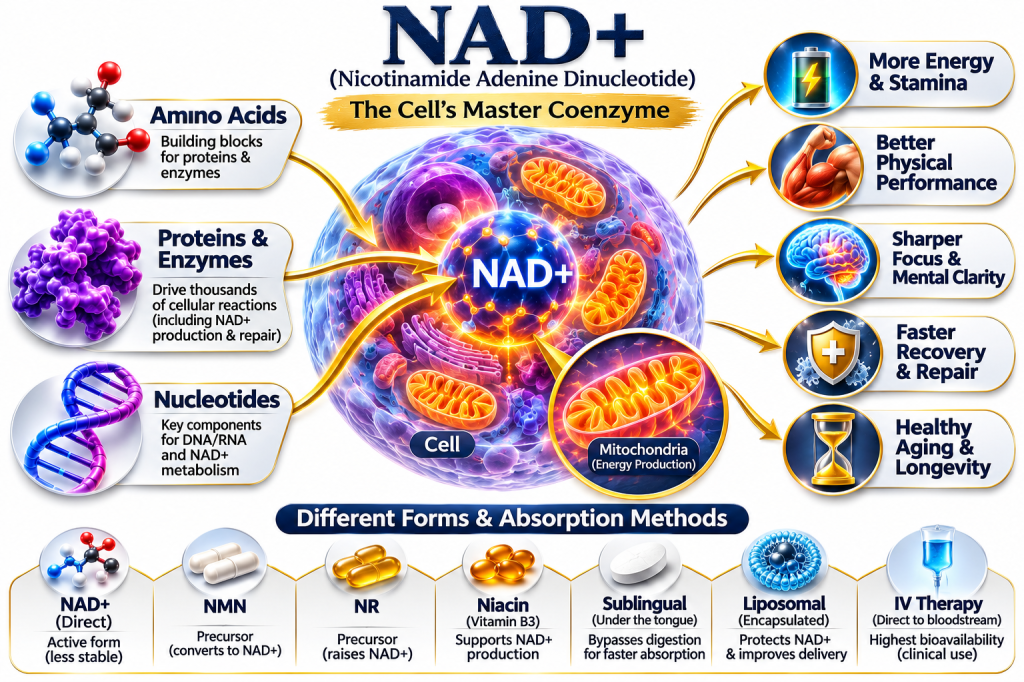
For years, longevity science operated under one rigid rule: you cannot take intact NAD+ orally. Because NAD+ is a large, charged molecule, stomach acid degrades it, and intact extracellular NAD+ cannot easily cross cell membranes without first being broken down by ectoenzymes (like CD73) into smaller precursors (Nikiforov et al., 2011).
That biological bottleneck is why NR and NMN dominated clinical trials, and why wellness clinics turned to IV NAD+ drips – which spike bloodstream concentrations rapidly but lack large-scale RCTs proving superior long-term clinical outcomes over oral precursors.
To bypass gut degradation, supplement companies introduced Liposomal NAD+ (encapsulating NAD+ inside phospholipid spheres). While small non-randomized pilot studies – such as a 14-person crossover study on liposomal NAD+ published in NDNR – suggested phospholipid delivery could elevate intracellular NAD+ over 14 days, critics rightly noted the absence of large, double-blind, placebo-controlled RCTs.
An Interesting Case…
While researching these clinical trials, I came across two remarkable 2026 peer-reviewed studies on a completely different delivery architecture called “LathMized® NAD+ (LNAD+)“ – developed alongside researchers from the Institute for Systems Biology and Texas A&M University.
- The RENEWAL-NAD+ RCT (Kornilov et al., July 2026, GeroScience): Rather than using standard phospholipid liposomes, LNAD+ uses a physicochemically modulated supramolecular formulation that alters how intact NAD+ behaves in solution without changing its native chemical structure. In this double-blind, placebo-controlled trial (NCT07336836) of 60 adults aged 45–75 taking 2,000 mg/day (500 mg four times daily) for 5 days, whole-blood intracellular NAD+ jumped by 53% over placebo (p=5.48×10⁻¹⁴), with a 100% response rate. Even more intriguing: circulating plasma NAD+ remained completely unchanged (p=0.60), while downstream catabolites (MeNAM and 2PY) surged and plasma SIRT1 protein rose by 32% – indicating targeted intracellular uptake and metabolic flux without flooding the bloodstream.
- The October 2026 Surgical Wound Healing Case Study (Hastings et al., Oct 2026, Plastic and Reconstructive Surgery – Global Open): Building on RENEWAL-NAD+ biomarker findings – which showed suppression of matrix-degrading enzymes (MMP9, CXCL10/12) and activation of angiogenic (VEGF) and DNA repair pathways – researchers documented a 59-year-old woman with hypertension, hyperlipidemia, and prior severe surgical infections who suffered deep incisional wound splitting (dehiscence) after bilateral brachioplasty (arm lift) surgery. On postoperative day 18, she independently began taking 1,500 mg/day of oral LNAD+. Within 24 hours, wound depth began contracting; by day 22 of supplementation (postoperative day 40), the deep wound achieved 100% closure with minimal scarring, compared to the typical 6 to 12 weeks expected for secondary healing.
These are interesting as they are talking about an “oral NAD+” that seems to be super effective, even without precursors? The studies don’t mention that, so I’m in the process of hunting down and interviewing all the folks in these trials. Don’t hesitate to let me know if you’d like to share the details of my “Biohacking From The Source™” quest.
Top 10 Questions About NAD+ and Longevity Answered
1. What is NAD+?
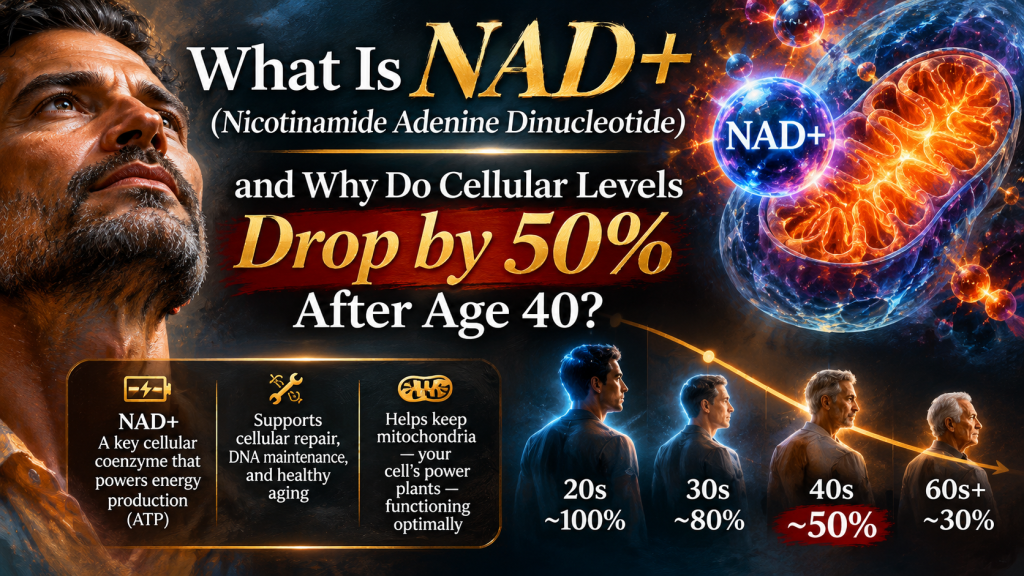
NAD+ (Nicotinamide Adenine Dinucleotide) is a foundational coenzyme present in every living cell. It drives mitochondrial ATP energy production, fuels PARP enzymes for DNA repair, and activates sirtuins to regulate inflammation and cellular aging.
2. Why do NAD+ levels decline with age?
Levels fall due to a double bind: chronic low-grade inflammation (“inflammaging”) and accumulated DNA damage hyper-activate NAD+-consuming enzymes like CD38 and PARPs, while the body’s enzymatic salvage pathways become less efficient at recycling NAD+.
3. Can NAD+ truly reverse aging?
No. Current human evidence in 2026 shows that boosting NAD+ supports healthspan– helping preserve cellular energy, vascular elasticity, and metabolic resilience – rather than reversing decades of structural aging. It is an optimization tool, not a fountain of youth.
4. What is the difference between NAD+, NMN, and NR?
NAD+ is the active coenzyme. NR and NMN are smaller vitamin B3-derived precursors that enter cells and convert into NAD+. Historically, precursors outperformed standard oral NAD+ because unformulated NAD+ degrades in the gut and struggles to cross cell membranes – though 2026 clinical data on supramolecularly modulated formulations like “LNAD+ shows intact oral NAD+ can rapidly elevate intracellular levels when engineered properly.
5. Are NAD+ supplements safe?
Human RCTs consistently show oral NR (up to 2,000 mg/day) and NMN (up to 1,200 mg/day) are well-tolerated over multi-week and multi-month trials. Short-term trials of LNAD+ (2,000 mg/day) also showed an excellent safety profile. However, multi-year safety data is still accumulating, and anyone with active cancer or severe liver/kidney disease should consult a physician first.
6. What benefits can I realistically expect from boosting NAD+?
Realistically, you may experience steadier cellular energy, modest improvements in physical endurance or recovery, and measurable improvements in metabolic or cardiovascular biomarkers (especially if you are older or have baseline metabolic stress). Dramatic overnight transformations are marketing hype.
7. How can I naturally boost my NAD+ levels?
Resistance and aerobic exercise, time-restricted eating/caloric moderation, restorative sleep, and avoiding excessive alcohol or UV damage all naturally upregulate NAMPT (the rate-limiting enzyme in the NAD+ salvage pathway) while minimizing unnecessary NAD+ depletion.
8. Is IV NAD+ superior to oral supplements?
IV NAD+ bypasses digestion to flood the bloodstream immediately, which can produce acute subjective clarity (alongside temporary chest tightness or flushing if dripped too fast). However, as of 2026, rigorous RCTs have not proven that IV NAD+ produces superior long-term clinical outcomes compared to clinically dosed oral precursors or advanced oral formulations.
9. Which organs benefit most from maintaining NAD+ levels?
High-energy, mitochondria-dense organs show the clearest dependence on NAD+: the brain (neuroprotection and cerebral bioenergetics), the heart (vascular elasticity and cardiac muscle output), the liver (insulin sensitivity and lipid metabolism), and skeletal muscle (oxygen utilization and endurance).
10. What is the outlook for NAD+ in longevity medicine?
The industry is rapidly maturing from blind supplementation to precision biomarker tracking – using intracellular NAD+ blood spot testing before and after intervention, pairing targeted precursors or bioavailable NAD+ formulations with lifestyle foundations, and demanding human RCT proof over animal-model hype.
That’s it for now. Please let me know your thoughts and if any of the studies are of particular interest to you. I’ll be happy to dig deeper and report what I find.
Cheers,
Sid Peddinti


Leave a Reply